
Verve
⏳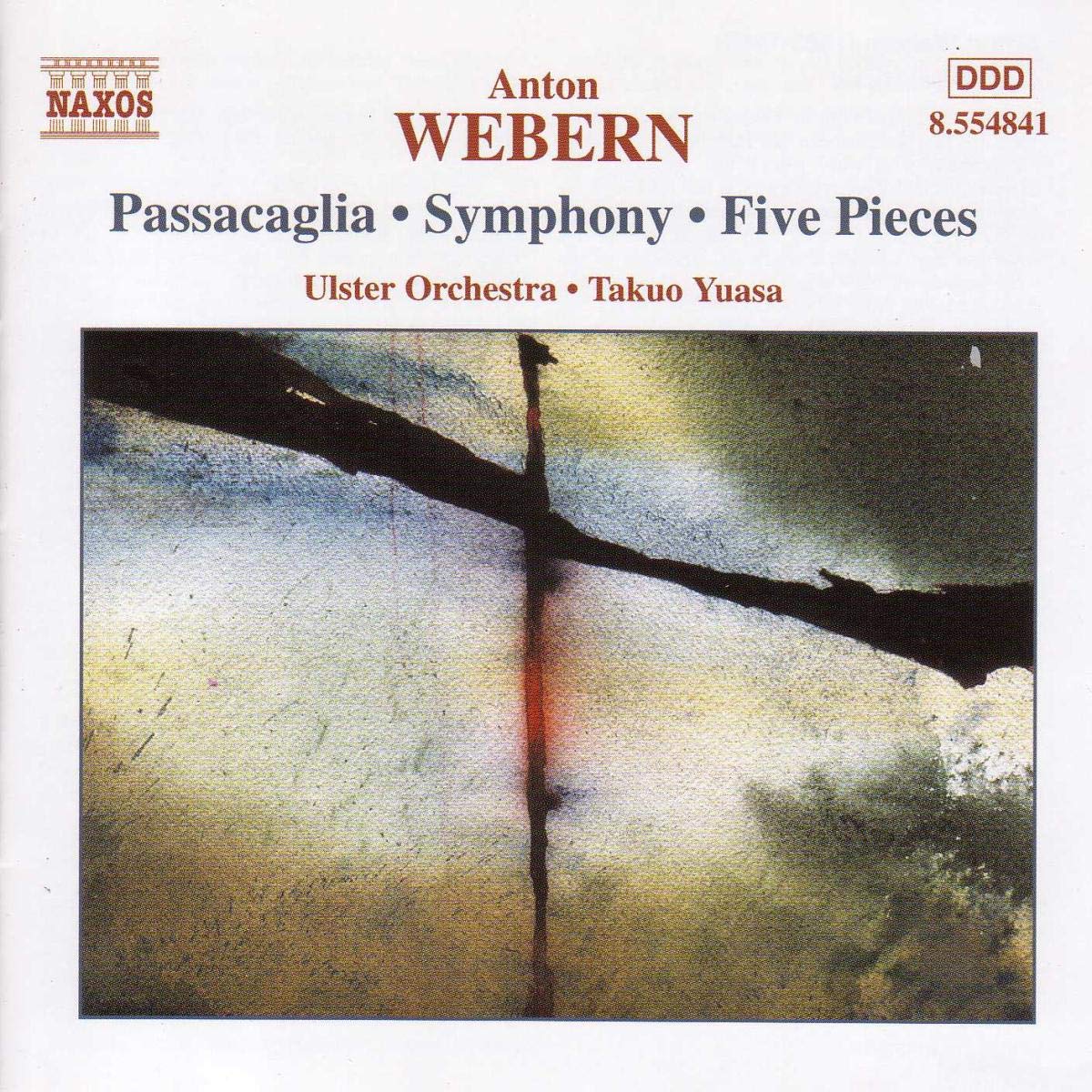
Amazon.co.uk These works on this disc of orchestral music by Webern take us from 1908 through to 1940, during which period the composer progressively compressed his musical argument into the briefest time-frames. The longest single movement here is the Passacaglia at around ten minutes. Elsewhere come the often fleeting yet still deftly coloured movements of the Six Pieces Op.6 and then the Five Pieces Op.10, none of which lasts longer than 1'44". These works also encompass Webern's journey from the limits of tonality to the vastnesses of 12-tone outer-space. Some passionately identify with the purity of Webern's ideas, others claim they're more about maths than music and the human soul. Just how human it all seems depends of course on the quality of performances--the acute ear for sound and musicality of a Boulez or a Karajan dispel doubts. Here Yuasa and the Ulster Orchestra score highly, and there are many fine solo contributions. The dramatic episodes in the Passacaglia are delivered with the utmost force within a well-controlled and shaped reading, while the Five Movements and the Six Pieces are especially atmospheric. Recorded sound is good, if a fraction on the lively side. An economical way of sampling the Second Viennese School. --Andrew Green Product Description Anton Webern (1883-1945)Orchestral MusicAnton Webern was born in Vienna on 3rd December 1883. His first compositions date from before the turn of the century, with early pieces that are competent exercises in mid-Romanticism, as in the 1904 idyll Im Sommerwind (In the Summer Wind). In 1904 he began an intensive period of study with Arnold Schoenberg, who was then working towards an expansion of the tonal boundaries of Western art music. After formal tuition ended in 1908, Schoenberg continued to act as a mentor and advisor to Webern until he left Germany in 1933. Between 1908 and 1920, apart from a brief period of war service, Webern took up, and often quickly abandoned, conducting posts throughout the Austro-German territories, while writing a sequence of works, the temporal proportions of which were increasingly compressed. In 1920 he settled at Mödling, near Vienna, where he earned a living through choral conducting and private teaching. There were also conducting engagements abroad, notably with the BBC Symphony Orchestra, though Weberns painstaking and ascetic manner found little favour. Nevertheless, with the support of his publisher Universal Edition, he composed steadily through to the early 1940s, though the annexation of Austria by Germany in 1938 left him with little means of support and no public performances. In Mittersill, near Salzburg, with his wife at the end of World War Two, he was preparing to return to Vienna when, on 15th September, he was shot and killed by an American soldier in a tragic case of mistaken identity. With fellow-members of the Second Viennese School, Schoenberg and Berg, Webern was a great believer in innovation within the Western musical tradition. This reflected itself, in his case, in particular emphasis on the polyphonic composers of the Renaissance and early Baroque (he was awarded a doctorate in 1906 for his study of Heinrich Isaac). In the words of his pupil, the British composer Humphrey Searle, "Webern was an idealist, completely dedicated to his conception of music, which he regarded as a phenomenon of Nature rather than Art: he was always aiming to find the natural laws which music must follow". The Passacaglia, Opus 1, was written in 1908, towards the end of Weberns four-year period of formal composition lessons with Schoenberg. A set of variations on a ground bass, the passacaglia is among the strictest of classical forms, and one in which Weberns inclination towards contrapuntal writing, the combination of individual musical lines, is fully engaged. The eight-bar theme, announced by plucked strings, contains one note foreign to the key of D minor, which enables Webern to pursue the chromatically extended approach to tonality that Schoenberg had been pursuing in his most recent works. That said, the strict, often austere logic of the piece recalls Brahms, notably the Bachian passacaglia which concludes his Fourth Symphony. Indeed, Weberns Passacaglia connects w
Customer reviews
10 Trustpilot reviews total, with 2 shown at a time.
I wrote to Bigamart's customer support and they accompanied the process of reshipping the item until it finally arrived. I felt a genuine effort to solve the problem till it was finally solved.
The package was here in Australia from England in a few days — so quick! Something was missing and they refunded it straight away. Pretty happy with these guys.
You might also like