Sony
⏳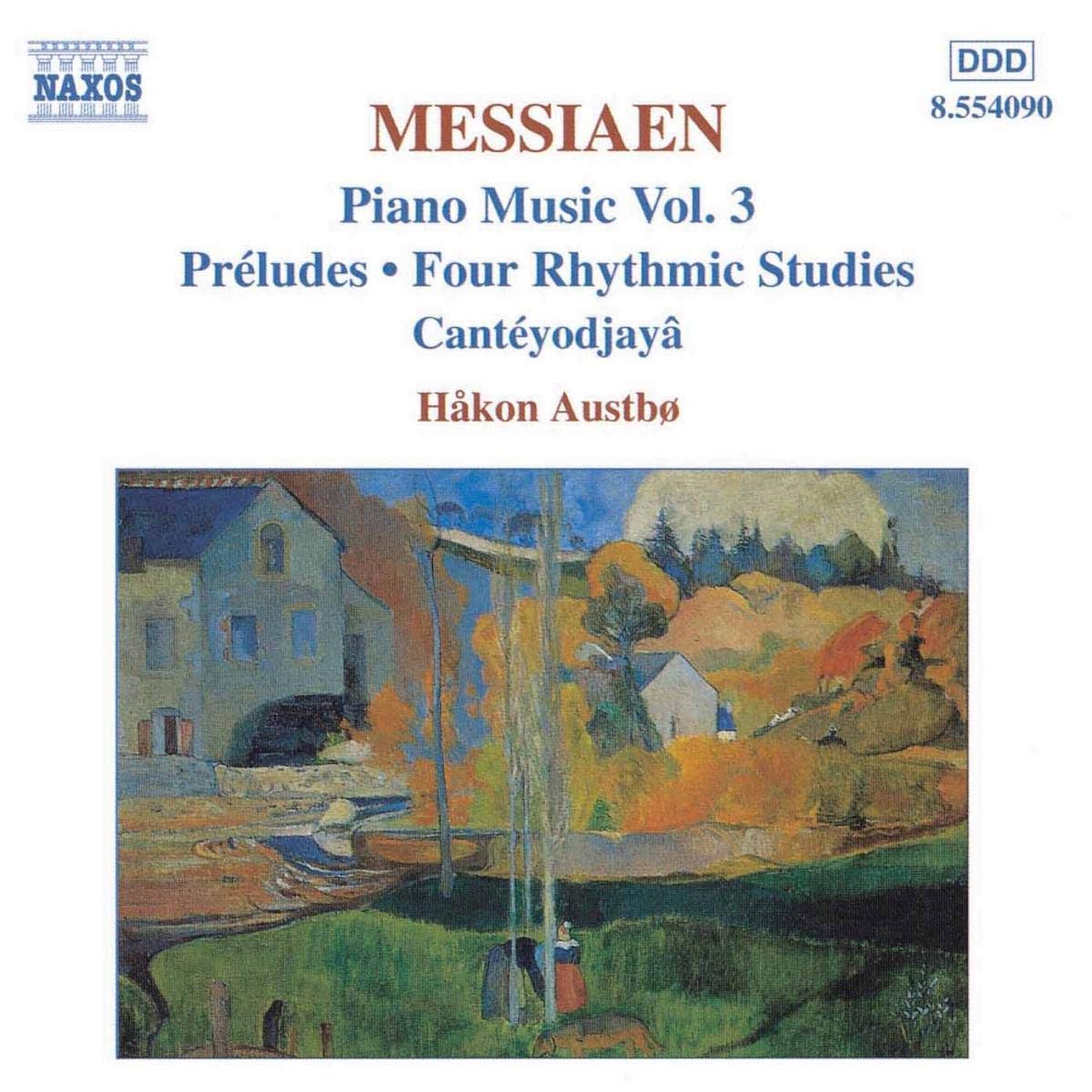
Amazon.co.uk It might surprise those who think of Messiaen as a composer of emotional--and temporal!--blockbusters to know that among his earliest published works is this modest set of Eight Preludes, completed in 1929 at the time of his graduation from the Paris Conservatoire. Yes, the shadow of Debussy looms large in Messiaen's musical thinking at this stage, not least in terms of piano technique, but there's also a freedom of harmonic and rhythmic thinking that looks forward to the innovations to come. The titles sound oblique quoted away from the music, but the even-numbered preludes, in particular, are every bit as imaginative as they sound. 20 years on, and the Four Rhythmic Studies are from a vastly-changed world--musical and otherwise. This was the period when Messiaen was (unwittingly) showing the way forward to the rebellious spirits of the post-war avant-garde. Not that you need to decode this music in order to enjoy its prismatic colours and textures. Cantéyodjaya too inhabits a world not so different from that of Messiaen's flamboyant orchestral masterpieces. Thoughtful, attentive performances from Austbø make for a disc enjoyable and stimulating. --Richard Whitehouse Product Description Olivier Messiaen(1908-1992) Piano Music Volume 3Olivier Messiaen is among the most influential figures in the music ofthe twentieth century. At first alarming and shocking audiences, he later wonan unassailable position, respected at home in France and abroad for hisachievement through a musical language that is intensely personal, emotionaland informed by a deep Catholic piety. Born in Avignon in 1908, he startedpiano lessons in 1917 and two years later entered the Paris Conservatoire,where his teachers included Marcel Dupre, Maurice Emmanuel and Paul Dukas. In1931 he was appointed organist at La Trinite and held this position until hisdeath, writing, particularly in the 1930s, a number of important compositionsfor the organ. In 1940, as a prisoner-of-war in Silesia, he wrote his Quatuorpour la fin du temps ('Quartet for the End of Time'), returning, on hisrelease in 1942, to the Conservatoire. There he taught harmony but exercisedeven stronger influence in the following years through his teaching of analysisand his work at various centres abroad. As a composer his attention was nowturned also to composition for the piano, inspired by his pupil Yvonne Loriod,who became Messiaen's second wife in 1962, three years after the death of hisfirst wife, the violinist Clajre Delbos. Yvonne Loriod continued as a leadingexponent of his music. In 1966 Messiaen became professor of composition at theConservatoire and the following year was appointed a member of the Institut deFrance. In 1971 he received the Erasmus Prize and in 1978 retired from theConservatoire, although his influence continued unabated. He died in Paris in1992.Messiaen's very personal musical language was derived from a number ofsources. His interest in bird-song is directly evident in his Oiseauxexotiques ('Exotic Birds') and Catalogue d'oiseaux ('Catalogue ofBirds', Naxos8.553532-34) and indirectly elsewhere in his music. Describing himself as a rythmicien,he had a profound interest in Greek verse rhythms, Hindu rhythms and therhythms of major Western composers, from Claude Le Jeune to Debussy andStravinsky. His harmony draws on a combination of sources, from serialism andatonality to tonal and modal writing, with an idiosyncratic use of organregistration and orchestral colour.The eight Prelude, were published in 1929, while Messiaen wasstill a student, at the instance of Paul Dukas. While the titles sometimessuggest Debussy, the music itself shows considerable originality. The first ofthe set, La colombe ('The Dove'), is evocative in its binary form, thesecond half repeating the first until the final gentle ascent, acharacteristically symmetrical piece Chant d'extase dans un paysage triste ('Songof Ecstasy in a Sad Landscape') is similarly clear in structure. The openingsection, presented simply at first, frames a chordal section before returningin fuller form. At the heart of the piece is new material, ecstatic in mood,framing in turn a central section that presents its melodic material
Customer reviews
10 Trustpilot reviews total, with 2 shown at a time.
I wrote to Bigamart's customer support and they accompanied the process of reshipping the item until it finally arrived. I felt a genuine effort to solve the problem till it was finally solved.
The package was here in Australia from England in a few days — so quick! Something was missing and they refunded it straight away. Pretty happy with these guys.
You might also like