
Academic Press
⏳Knowledge Management
Data Governance: How to Design, Deploy, and Sustain an Effective Data Governance Program
$139.99
View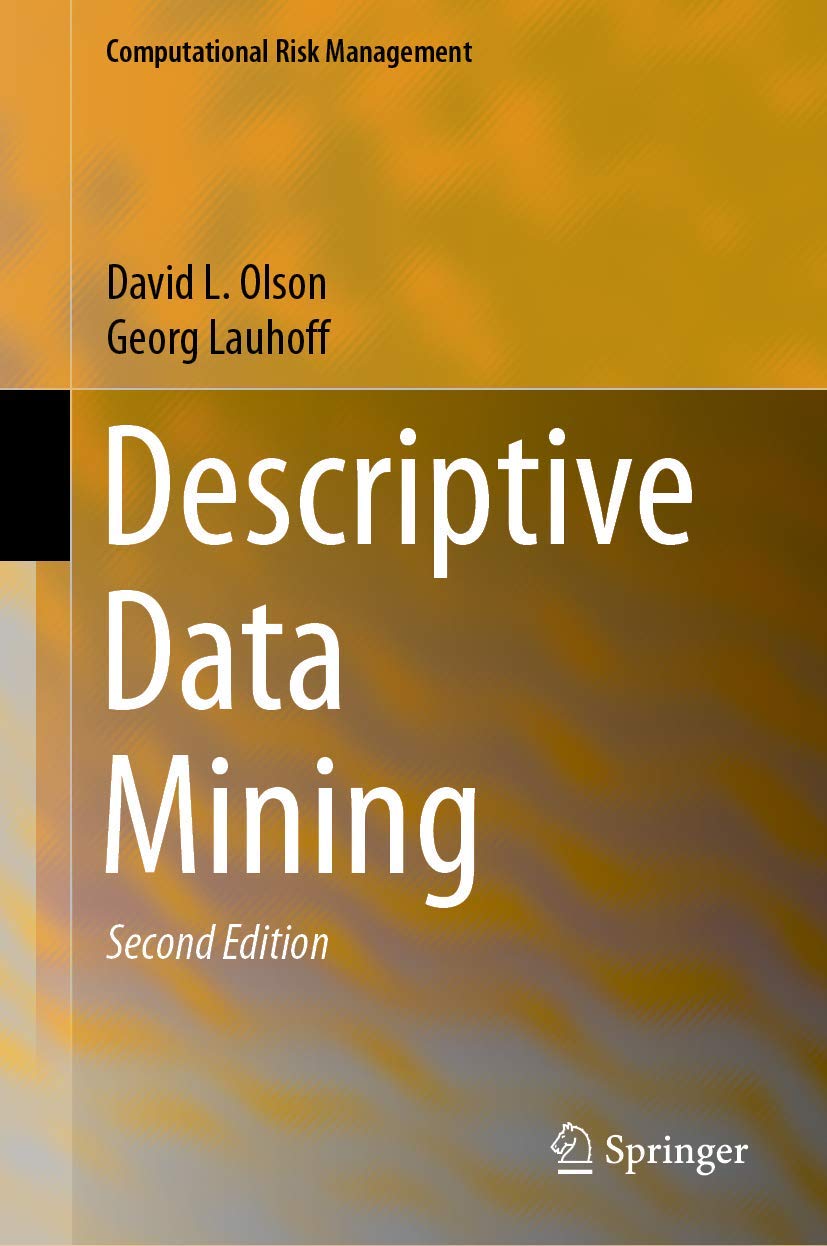
Product Description This book provides an overview of data mining methods demonstrated by software. Knowledge management involves application of human knowledge (epistemology) with the technological advances of our current society (computer systems) and big data, both in terms of collecting data and in analyzing it. We see three types of analytic tools. Descriptive analytics focus on reports of what has happened. Predictive analytics extend statistical and/or artificial intelligence to provide forecasting capability. It also includes classification modeling. Diagnostic analytics can apply analysis to sensor input to direct control systems automatically. Prescriptive analytics applies quantitative models to optimize systems, or at least to identify improved systems. Data mining includes descriptive and predictive modeling. Operations research includes all three. This book focuses on descriptive analytics. The book seeks to provide simple explanations and demonstration of some descriptive tools. This second edition provides more examples of big data impact, updates the content on visualization, clarifies some points, and expands coverage of association rules and cluster analysis. Chapter 1 gives an overview in the context of knowledge management. Chapter 2 discusses some basic software support to data visualization. Chapter 3 covers fundamentals of market basket analysis, and Chapter 4 provides demonstration of RFM modeling, a basic marketing data mining tool. Chapter 5 demonstrates association rule mining. Chapter 6 is a more in-depth coverage of cluster analysis. Chapter 7 discusses link analysis. Models are demonstrated using business related data. The style of the book is intended to be descriptive, seeking to explain how methods work, with some citations, but without deep scholarly reference. The data sets and software are all selected for widespread availability and access by any reader with computer links. Review “The book is direct and easy to read, explaining how methods work without in-depth scholarly references. … this is a suitable book for data mining newcomers who are not interested in a theoretical understanding of the algorithms. … the book could be used as a course resource.” (Evangelia Kavakli, Computing Reviews, November 2, 2020) From the Back Cover This book provides an overview of data mining methods demonstrated by software. Knowledge management involves application of human knowledge (epistemology) with the technological advances of our current society (computer systems) and big data, both in terms of collecting data and in analyzing it. We see three types of analytic tools. Descriptive analytics focus on reports of what has happened. Predictive analytics extend statistical and/or artificial intelligence to provide forecasting capability. It also includes classification modeling. Diagnostic analytics can apply analysis to sensor input to direct control systems automatically. Prescriptive analytics applies quantitative models to optimize systems, or at least to identify improved systems. Data mining includes descriptive and predictive modeling. Operations research includes all three. This book focuses on descriptive analytics. The book seeks to provide simple explanations and demonstration of some descriptive tools. This second edition provides more examples of big data impact, updates the content on visualization, clarifies some points, and expands coverage of association rules and cluster analysis. Chapter 1 gives an overview in the context of knowledge management. Chapter 2 discusses some basic software support to data visualization. Chapter 3 covers fundamentals of market basket analysis, and Chapter 4 provides demonstration of RFM modeling, a basic marketing data mining tool. Chapter 5 demonstrates association rule mining. Chapter 6 is a more in-depth coverage of cluster analysis. Chapter 7 discusses link analysis
Customer reviews
10 Trustpilot reviews total, with 2 shown at a time.
I wrote to Bigamart's customer support and they accompanied the process of reshipping the item until it finally arrived. I felt a genuine effort to solve the problem till it was finally solved.
The package was here in Australia from England in a few days — so quick! Something was missing and they refunded it straight away. Pretty happy with these guys.
You might also like