Sony
⏳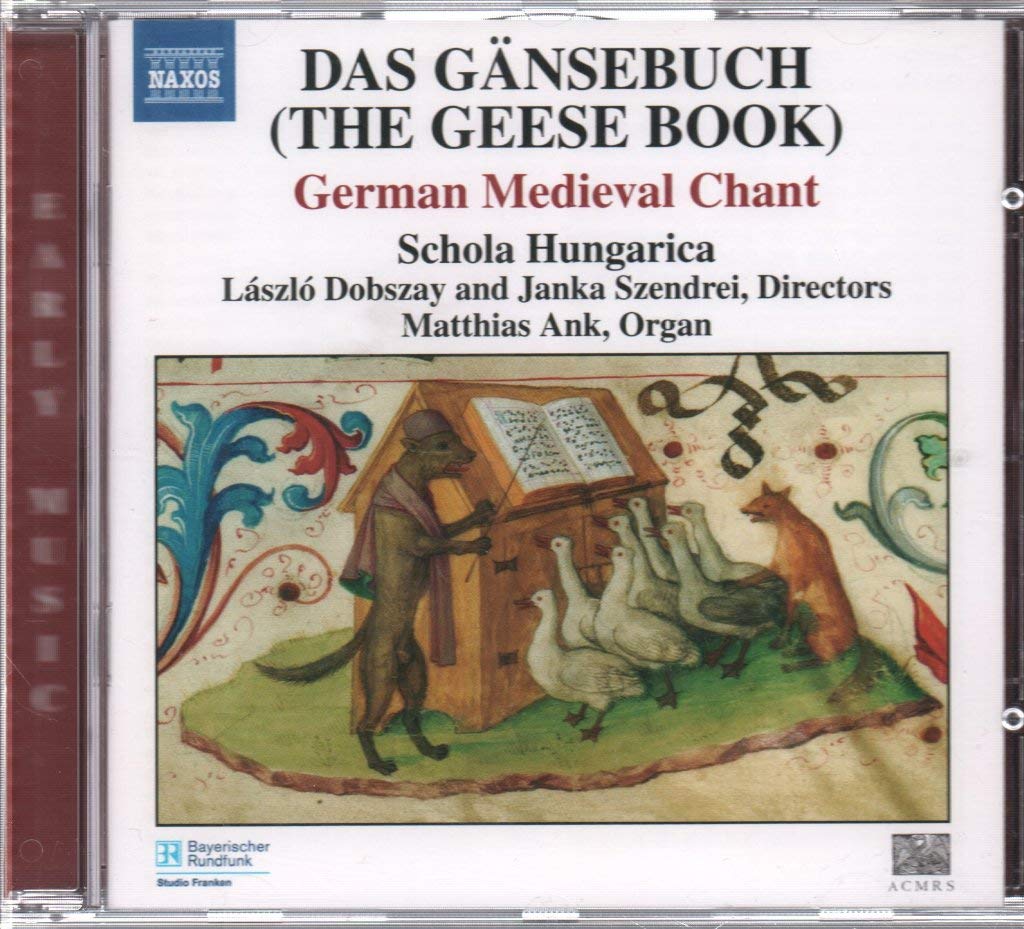
Medieval Chant from NurembergDas Gansebuch (Geese Book)In the fourteenth and fifteenth centuries the freeimperial city of Nuremberg assumed great economicimportance through the production of metal goods andtrade in metals, textiles and spices. Nuremberg proudlydisplayed the wealth it had amassed: not only was thesplendour of the city's civic buildings and ceremoniesunsurpassed, but also that of both its Gothic parishchurches, St Lorenz and St Sebald. In each parish, amember of the city council was appointed as trustee andbusiness administrator overseeing the finances that thecity provided to support and furnish the parishes andtheir edifices. The parish churches also reflected theself-assurance of the city musically, through theirfestive liturgies. To this end both churches sponsoredwell-known schools, the task of which was to trainsingers for the liturgy. Nuremberg was part of thediocese of Bamberg and had to take its lead from theliturgy of the seat of the bishop, Bamberg Cathedral.The surviving liturgical manuscripts show that, in spiteof this dependency, the rich Nuremberg churchesdeveloped a characteristic and in many waysindependent liturgy that incorporated divergentelements. The basis of the music, the roots of which layin the Bamberg liturgy of the eleventh century, wascontinually augmented by chants from newlyintroduced feast days.Shortly after 1500 the parish of St Lorenzcommissioned a two-volume Gradual, a book in whichthe music of the Mass liturgy for the choir wascollected. The last time a Gradual for the church hadbeen made was in 1421. Since then several importantfeast days had been introduced. A prebendary of StLorenz, Friedrich Rosendorn, was charged with therevision of the liturgy and the writing of the text andmusic. According to the colophons the first volume wasfinished in 1507, and work on the second wascompleted in 1510. Friedrich Rosendorn had died in theyear the first volume was finished, and it is not knownwho was in charge of the copying of the second volume;a visible stylistic break between the volumes is notevident.The size and elaborate decoration of the manuscriptreflect the prestige of the church. The high feasts of thechurch year were set off with detailed illuminations,attributed to the well-known Nuremberg painter JakobElsner, who died in 1517. Some initials are ornamentedwith gold-leaf, others are historiated and contain scenesshowing the events commemorated on the importantfeast days. The margins exhibit colourful acanthustendrils and buds inhabited by animals, birds, angels,wild folk, and dragons. In some cases therepresentations in the lower margin develop into richnarrative scenes, in which animals act as people,particularly as musicians. Numerous hunting andcombat scenes are found throughout the book. Thesesometimes provocative allegories function on variouslevels. Common to all is their basic multivalence andtheir applicability in various contexts. Bookilluminations had long established themselves as ave
Customer reviews
10 Trustpilot reviews total, with 2 shown at a time.
I wrote to Bigamart's customer support and they accompanied the process of reshipping the item until it finally arrived. I felt a genuine effort to solve the problem till it was finally solved.
The package was here in Australia from England in a few days — so quick! Something was missing and they refunded it straight away. Pretty happy with these guys.
You might also like