
Verve
⏳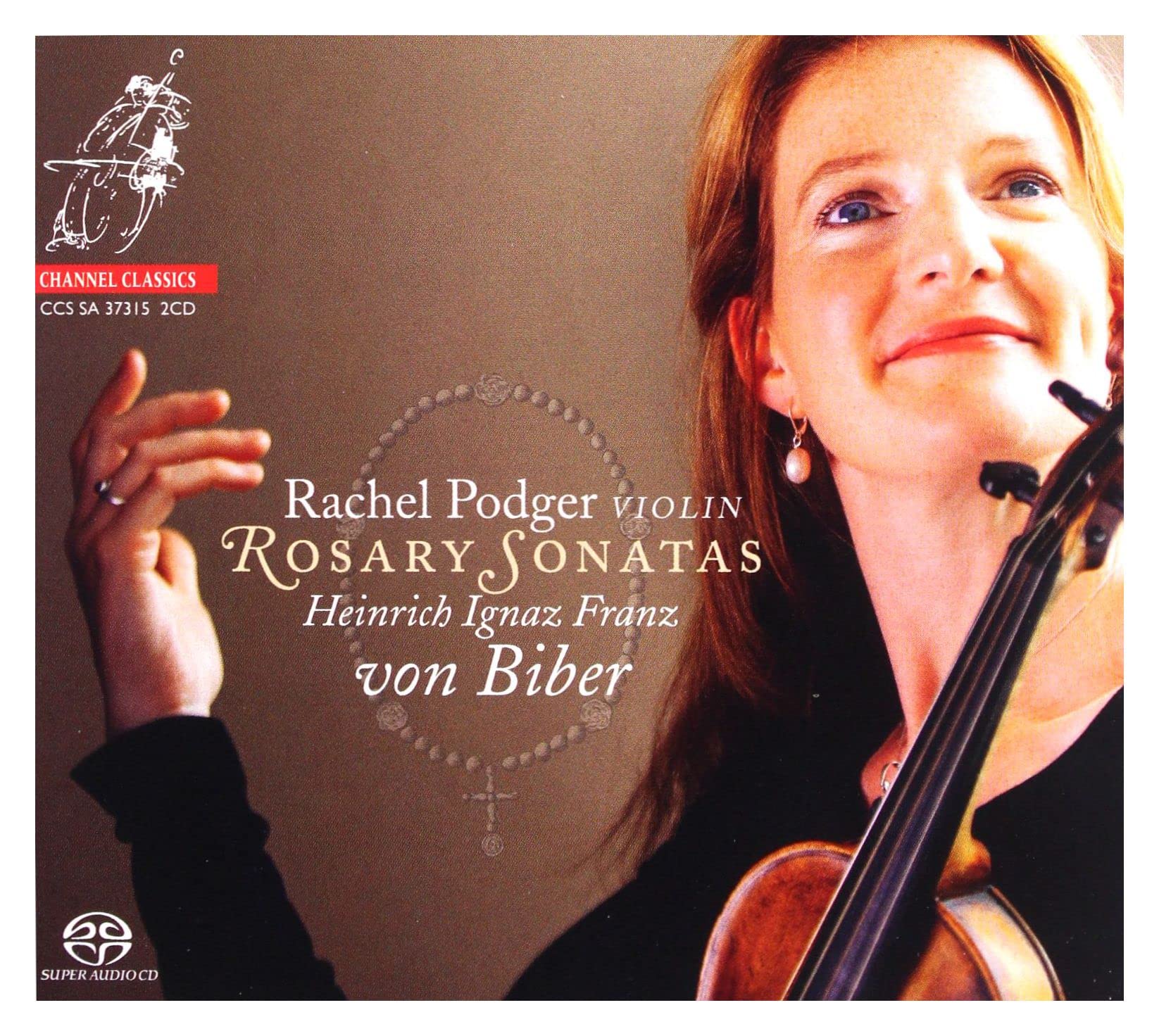
Product Description Gramophone Classical Music Awards 2016 - Baroque Instrumental category winner! The Rosary (Mystery) Sonatas, even today, are considered the most extensive example of scordatura. From the Italian discordare meaning out of tune, scordatura is a technique whereby the strings are purposefully tuned differently from their usual arrangement. Here the usual G-D-A-E tuning, where the violin strings are consistently a perfect fifth apart, is only used for the opening Sonata and the closing Passacaglia. The other fourteen sonatas each have a different configuration of tuning. Compositionally this allowed Biber to obtain unusual chords, opening up a whole new spectrum of harmonic and textural possibilities. This fundamentally altered what a violin was and could be; its physicality as well as its voice was transformed. Rachel Podger: When performing a selection of these sonatas in concert I found it less taxing on the audience (and me!) to use a number of violins and tune them as I went along, so that the new tuning could settle on one violin whilst I played on another. For the recording I was convinced I needed to use my own violin for all of them. This is because I felt I could get the best out of my first-choice violin but also because it was fascinating to witness the changes it went through during the cycle. As Mark Seow describes in his note, the violin suffers, and in my case, so much so that the piece of tail gut (which is the thick piece of gut connecting the tail piece to the button on the bottom side of the instrument holding the tension of the strings in place) started to fray and look dangerously worn and so had to be replaced in the middle of the recording! Review Memorable new performances of one of the most astonishing sets of violin sonatas ever written, and written over 300 years ago at that. They are the Rosary Sonatas, or Mystery Sonatas by Heinrich Biber the bohemian composer who became Kapellmeister in Saltsburg, and eventually ennobled by the Emperor in 1690... it stretches the instrument and the violinist to the limit. For this recording Rachel Podger uses the same instrument throughout, putting it through the pain, as part of the fascination for her was how the sound changed from piece to piece as the violin suffer alongside Christ... ...you heard violinist Rachel Podger slowly subjecting her violin to more and more extreme tunings as Biber stretches the expressive possibilities of scordatura, with beautifully calculated continuo playing from keyboard player Marcin wi tkiewicz, and lutenist David Miller. Jonathan Manson is also waiting in the wings to add his cello playing to later mysteries. It's searching, absorbing, quietly captivating playing and a moving journey through one of the most imaginative sets of violin sonatas ever composed, ending with the final transformation of Guardian Angel the final passacaglia for solo violin that marks the end of the pilgrimage. It's a special performance I think and a warmly detailed recording to enhance it. A great way for the label to celebrate its 25th anniversary this year, and it's the CD Review Disc of the Week. --Andrew McGregor - CD Review Disc of the Week Not for nothing is Podger regarded today as queen of the baroque violin.Biber's cycle of 15 Mystery Sonatas essentially an instrumental description of the religiously important events in the lives of Christ and Mary, from the Annunciation to the Coronation of the Blessed Virgin is perhaps the most important body of work for the baroque violin before Bach's solo sonatas and partitas. Podger makes light of the virtuosic demands of this profound music, while never losing sight of it's religious significance. --Sunday Times - Hugh Canning I can remember so well some 40 years ago being utterly taken aback by an unaccompanied violin Chaconne by Heinrich Ignaz Franz Biber. Since then, Biber has become the mountain every period violinist wants to climb, and that Chaconne revealed as the last movement of a set of 16 sonatas depicting the mysteries of the rosary.They are fantastically complex works, with different violin tunings and multiple stoppings, so that Rachel Podger's accomplished new recording sounds like a battery of many violins. Fine continuo adds to the variety of sound, but it would have been good to see some of the woodcut pictures of the rosary that appear in Biber's score. Rachel Podger's response to this subtly depictive music is more meditative, even at times, perhaps introspective, than most of her rivals… her playing is both tenderly expressed and affectingly poignant. Nothing is overstated or overblown but instead she reveals a fine sense of proportion, unhurried, restrained but also passionate where the subject and music demand it. Her ornaments are tasteful and imaginative and her articulation cogent and communicative, and she is supported by a responsive continuo group.5/5 stars - BBC Music Magazine. --The Observer - Nicholas Kenyon
Customer reviews
10 Trustpilot reviews total, with 2 shown at a time.
I wrote to Bigamart's customer support and they accompanied the process of reshipping the item until it finally arrived. I felt a genuine effort to solve the problem till it was finally solved.
The package was here in Australia from England in a few days — so quick! Something was missing and they refunded it straight away. Pretty happy with these guys.
You might also like