Archiv Produktion
⏳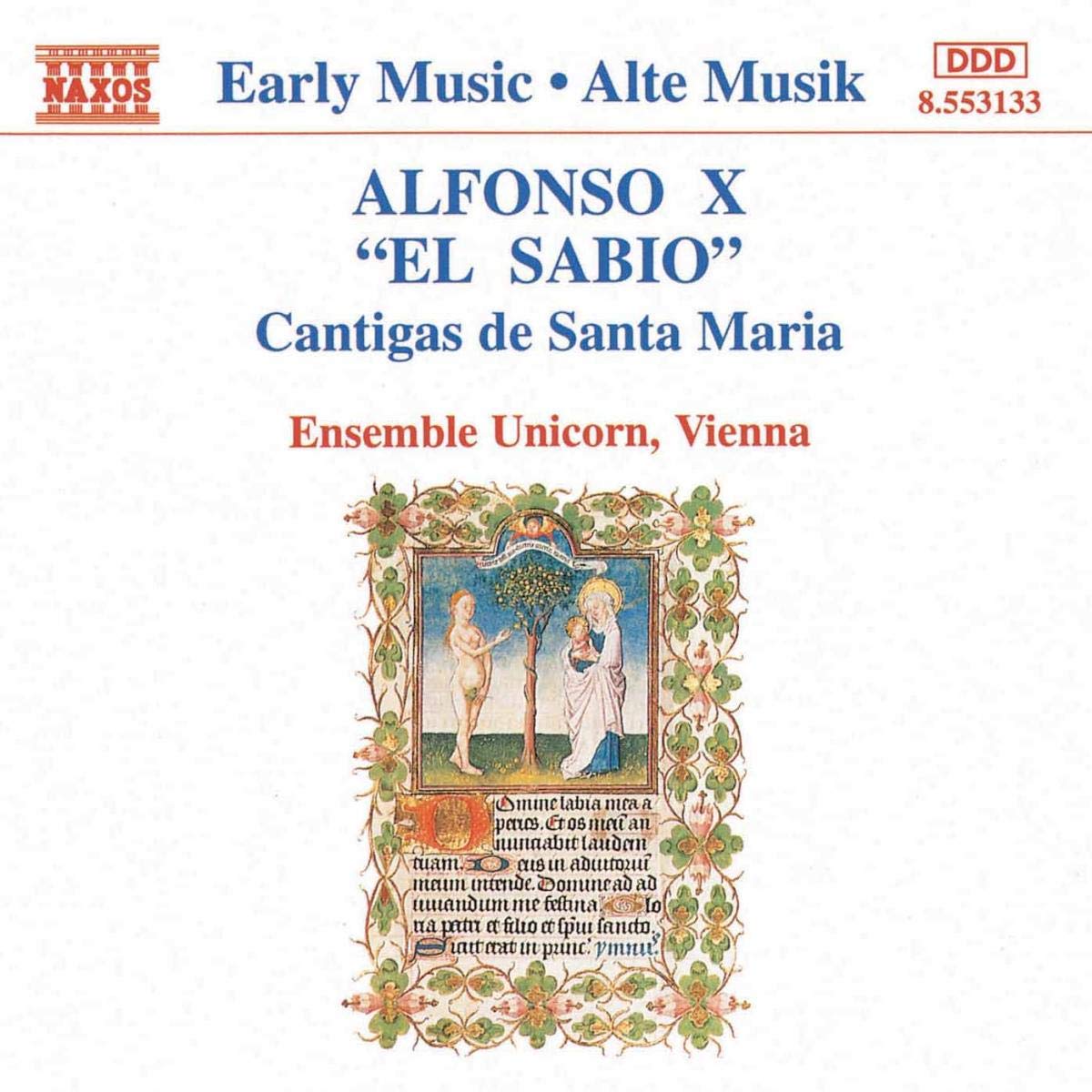
Entre Av'e Eva The Cantigas de Santa Maria of Alfonso X \el Sabio Alfonso X (1221 -1284), King of Castile and León, began his reign in a highly characteristic manner, by bringing together the staff of the University of Salamanca and explicity demanding que aya un maestro en organo (that there should be an organ teacher). He wanted academic studies to be complemented by artistic study. As a politician and a general he could look back on no great achievements, since the progress of the reconquista had proved troublesome during his reign and court intrigues eventually cost him his throne, yet as a patron of the sciences and arts he won the title el Sabio (the Wise), by which he is remembered in history. In the thirteenth century on the Iberian peninsula there was hostility between Moslems and Christians in warfare, but in everyday life there was a great deal of religious tolerance and lively exchange between the two opposing cultures. At the court of Alfonso there were learned Arab, Jewish and Christian scholars, who, under his direction, wrote comprehensive works such as the General estoria (General History), a monumental history of the world (fragmentary) and the Siete partidas (Seven Parts), a collection of laws. Special subjects were treated in the Libros del saber de astronomia (Books on the Science of Astronomy), El lapidario (The Book of Stones, Materials and Metals) and the Libros de ajedrez, damas y tablas (The Book of Chess, Draughts and Backgammon). These books today are seen as the foundation of Castilian prose-writing. In addition to his other scholarly interests, Alfonso also concerned himself with the arts, especially with music; as a young man he had himself composed love-songs. Provençal and Italian troubadours were frequent visitors to the Castilian court and Alfonso served as their patron and provided protection from the Inquisition during the suppression of the Albigensians. The German Minnesang may also have found a place there through Alfonso's mother, Beatrix of Swabia. The monophonic and polyphonic repertoire of Notre Dame was cultivated in the same way as the popular Cantigas de amigo, secular love-songs in Galician-Portuguese, the then poetic language. Music at court was not only performed by Christian musicians but also by Arab players with oriental dancers. In this varied musical life there appeared, with the cooperation and under the direction of Alfonso, the Cantigas de Santa Maria, a collection of more than four hundred monophonic songs. The musicologist Higinio Angles noted in the preface to his edition of the Cantigas (1943-1964) that even if no other Spanish music of the period survived, this would have been enough to put Spanish music on a par with the music of the other cultured countries of medieval Europe. The Cantigas have come down to us in four splendid manuscripts, three of them with notation. One of these is in the Spanish National Library in Madrid (No.10069), a second in the National Library
Customer reviews
10 Trustpilot reviews total, with 2 shown at a time.
I wrote to Bigamart's customer support and they accompanied the process of reshipping the item until it finally arrived. I felt a genuine effort to solve the problem till it was finally solved.
The package was here in Australia from England in a few days — so quick! Something was missing and they refunded it straight away. Pretty happy with these guys.
You might also like